When Trust Becomes the Threat. Behavioral Intelligence in an Artificial World
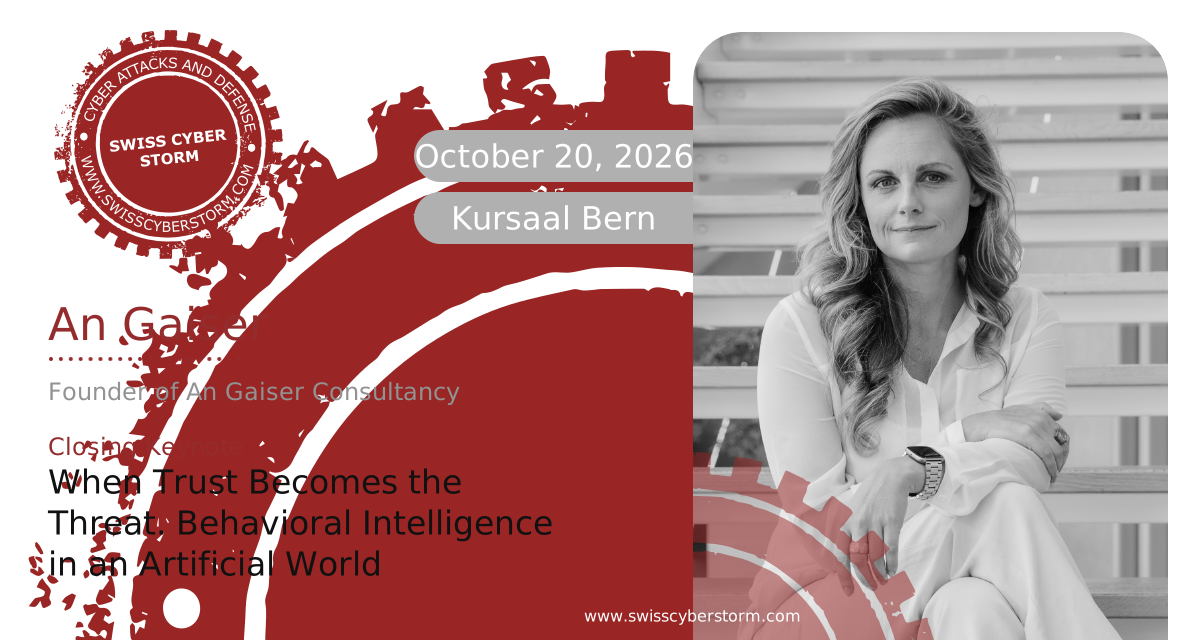
What happens when the signals we learned to trust: a familiar voice, a local dialect, authority, belonging, even the feeling that “this person is one of us”, can be artificially manufactured? Cybersecurity has spent decades teaching users to behave more rationally. But social engineering succeeds precisely because humans do not make decisions like security systems, especially under pressure. In this closing keynote, behavioral analyst An Gaiser explores trust as both a human vulnerability and a security capability. Through live audience interaction, Swiss cultural cues, AI-enabled deception, investigative interviewing and behavioral science, she challenges one of cybersecurity’s most persistent ideas: that the human is simply the weakest link. If we treat the people we are trying to protect as the problem, why would they trust us enough to report when something has gone wrong? The future of cyber defense requires more than deciding what is real. It requires understanding why humans trust what they trust, and becoming worthy of that trust ourselves?
AI Summary
Video chapters
0:00Introduction and intelligence background3:38Audience recognition poll8:35Observation versus interpretation11:34AI and the reliability of signals14:19Why humans cannot live in zero trust15:50Emotional hijacking under pressure20:27Awareness as earlier recognition22:35Blame, reporting and psychological safety24:52Becoming worthy of trust29:01Questions and answers
Key facts
- Gaiser has worked with human behavior and investigative interviewing for 25 years, including at the Dutch intelligence and security service, where she assessed whether people were who they claimed to be.
- Forensic psychology has moved away from interrogation toward truth-finding approaches when interviewing.
- In a live audience poll during the keynote, most attendees recognized Star Trek, but far fewer recognized Counselor Deanna Troi, the character whose role was to interpret emotions, motive and intent rather than data.
- A Dutch cyber security professional who had attended one of Gaiser's talks later recognized the stress of a manipulative phone call while it was happening and stopped the conversation.
Ideas
- Observation is not interpretation: voices, faces, uniforms, job titles, accents, logos and familiar email addresses are only signals, and humans attach the meaning, which is precisely what makes trust exploitable.
- AI does not need to change the human trust system; it only needs to feed familiar signals convincingly enough, such as a flawless Swiss dialect from a synthetic voice that triggers an instant sense of belonging.
- Social engineers manipulate not only the signal but the state in which it is interpreted, using urgency, authority, fear, scarcity, attachment, shame and hope to provoke an emotional hijack in which people fight, flee, freeze or affiliate and comply.
- Blaming people after they have been fooled destroys the trust needed for disclosure; better facts for incident mitigation require better conditions for reporting.
- Security culture rests on soft controls as well as hard controls such as access passes: leaders must role-model the behavior they want and make behavior transparent across the organization.
Keywords
- behavioral analysis
- social engineering
- emotional hijacking
- deepfakes
- trust
- socratic dialogue
Quotes
- “Signals do not arrive with meaning attached. We attach the meaning.”
- “Human trust isn't a bug. It's infrastructure.”
- “Why are we still designing rational solutions for irrational behavior?”
- “Awareness is not immunity. Awareness is earlier recognition.”
Recommendations
- After an incident, replace blame with open questions: instead of asking how someone could fall for it, ask what happened, what made it credible and what changed during the interaction.
- Design awareness programs to help people notice when their own decision-making starts to narrow under pressure, rather than promising that they will never be fooled.
- Chief information security officers (CISOs) and engineers should invest in soft controls and social skills, for example using Socratic dialogue so that people identify risks and solutions themselves, which makes compliance more likely.
Resources
- Socratic dialogue — Guide — Helps technical staff move from advising to guiding, increasing ownership of and compliance with security measures.
About the speaker

An Gaiser
As artificial intelligence reshapes the digital landscape, one question becomes increasingly important: why do intelligent people still make predictable decisions under pressure?
Behavioral analyst An Gaiser helps organizations answer that question. Drawing on more than two decades of experience in criminal justice, intelligence, forensic investigations, and executive advisory work, she translates behavioral science into practical strategies for cybersecurity, leadership, and high-stakes decision-making.
Read more …